Buying from a private seller.
A car bought from a person can be the best margin on your lot: no buyer fee, no transport. But nobody runs the paperwork for you. In GARAGEBIRDS a private-party car starts as a purchase, one record that holds the seller, the title, the loan, the money and the forms, and ends with the car in inventory at its real cost.
Cars from auctions and wholesalers go straight onto the vehicle record on every plan. A purchase is for the car someone drives in and sells you, where the title, the lien and the payments are yours to get right.
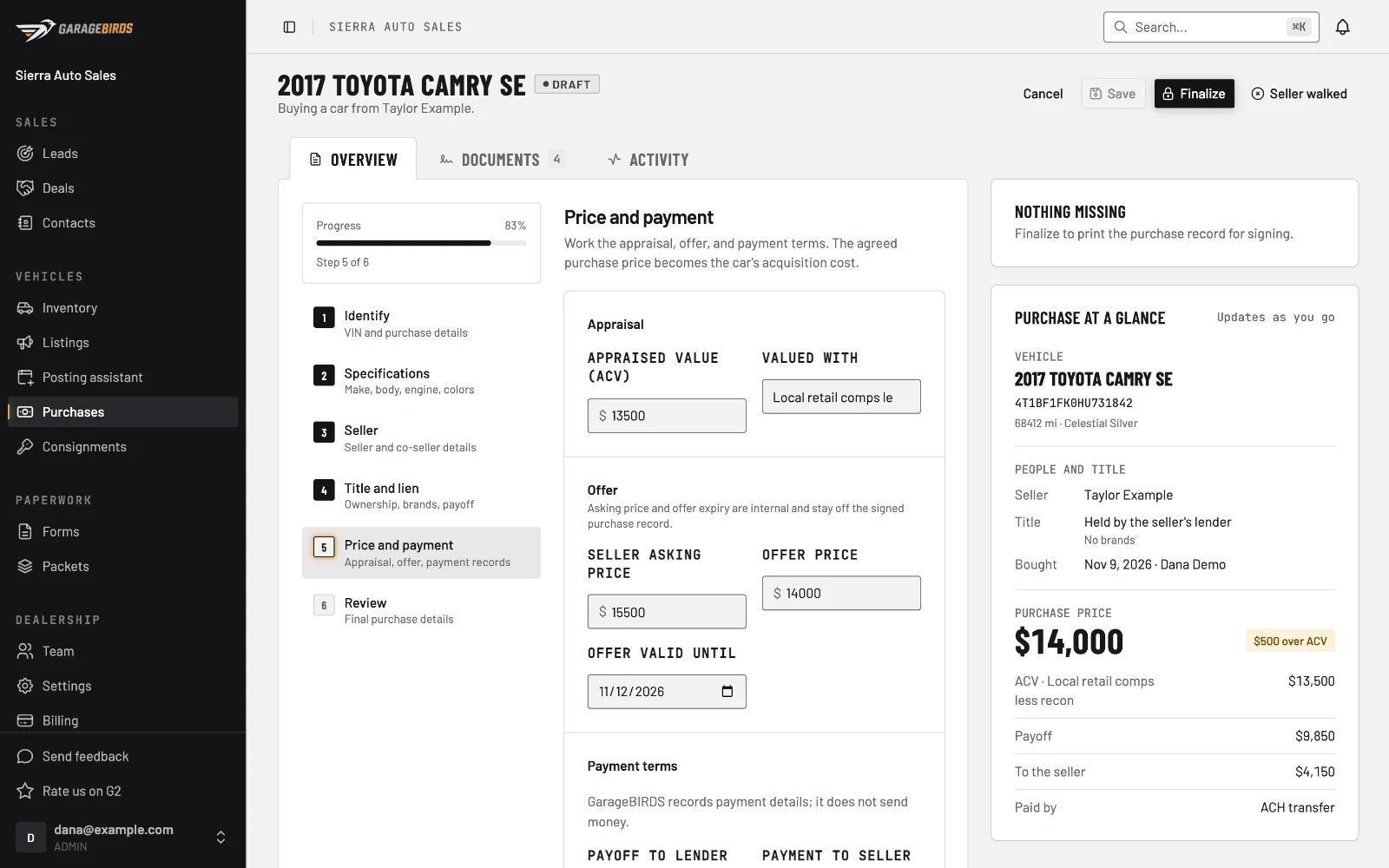
Their driveway. Your lot.
Fill the sections in any order and save as you go. The purchase lists what it still needs before it can be finalized, so nothing gets missed at the desk. The checks worth running before you make an offer are in our checklist for buying from a private seller.
- The seller. Every owner on the title, with their address and driver’s license, saved as contacts. A co-seller is required when the title joins two owners with “and”.
- The car. Enter the VIN and the specs decode. A VIN already in your inventory is refused, so the same car can’t come in twice.
- The mileage. The reading the seller discloses, and whether it isn’t actual or exceeds the odometer’s limits. A statement that leaves out an odometer brand on the title is refused.
- The title. Its number, state, issue date and status, how the owners are joined, the brands printed on it, and any lienholder.
- The offer and the price. Keep the seller’s asking price and the day your offer runs out on the purchase; neither ever prints. Agree the price, and the money works itself out.
- Finalize, print, sign, complete. Finalizing freezes the record and its paperwork. Completing puts the car into inventory.
Pay off the loan. Not the surprise.
When the seller still owes on the car, the lender is paid first and the seller gets the rest. Enter the payoff, the date it’s good through and its daily interest from the payoff letter, and GARAGEBIRDS shows what goes to the lender and what goes to the seller as you type.
| A worked example | Amount (USD) |
|---|---|
| Agreed price | 14,000 |
| Lender’s payoff good through Friday, paid to the lender directly | −9,850 |
| Paid to the seller | 4,150 |
When the payoff is bigger than the price, the purchase shows the seller’s shortfall instead, so you settle who pays it before anyone signs. Each payment — the payoff, the seller’s money and any shortfall — carries its method, its check or transfer reference and its date. References can be added after the paperwork is final, because the payoff often goes out after the car is in, and every change is kept on the purchase’s timeline.
The paperwork, filled in from the purchase
The forms fill from the saved purchase, with the person as the seller and your dealership as the buyer:
- The state’s transfer forms — bills of sale, odometer statements, notices of sale and releases of liability, and powers of attorney — wherever your state has them. When the title is from another state, that state’s forms are offered too.
- Your own purchase forms through Smart Print Forms, with purchase packets kept apart from your deal packets.
- A purchase record: one page with the dealership, the sellers, the car, the odometer, the title and its brands, the price, the payoff to the named lender, what the seller gets and how each payment is made, with a signature line for each side. It’s your record of the purchase, not a contract.
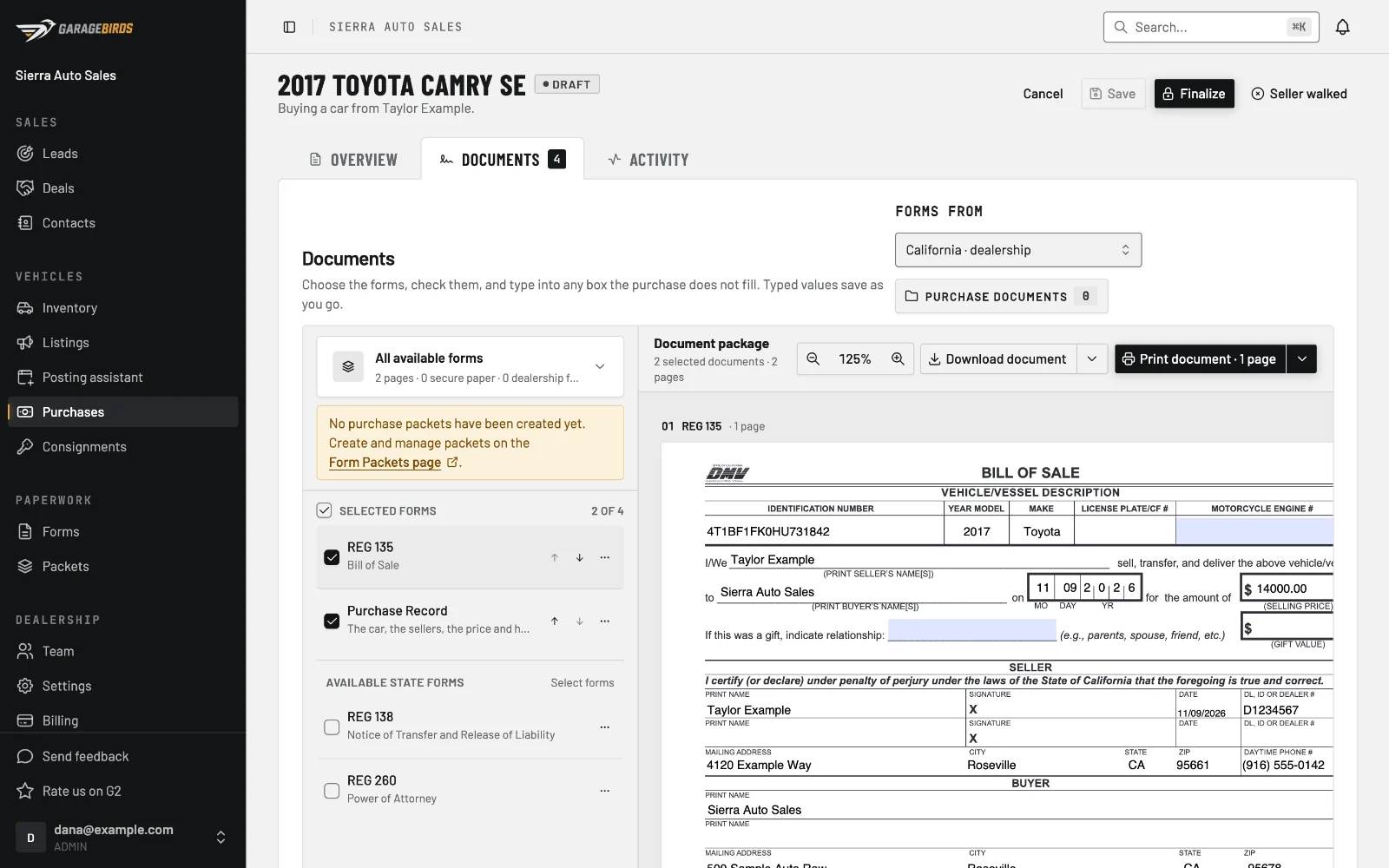
A box no purchase value fills can be typed into while the purchase is a draft. The signed pages, and anything else worth keeping such as the seller’s ID, are captured on the purchase; finalizing freezes the signed copies. Every form prints ready to sign in ink.
Into inventory at its real cost
Completing the purchase creates the car in inventory as a draft, with its acquisition cost, the purchase date, its source as a private party, its specs and mileage, and its title already filled in — the owner’s name from the sellers, the brands, the lienholder. From there it’s an ordinary car: add the recon, list it, sell it, and its true profit starts from what you really paid.
Titles often arrive weeks after the car. GARAGEBIRDS counts the days you’ve been waiting, and warns — never blocks — when a car is listed or put on a deal before its title is in hand.
When a purchase falls through
A seller who walks before the paperwork is final is marked lost, with a note; they stay a contact like any prospect. A purchase that falls apart afterwards — a title problem, a stolen car, a payment that failed, the seller cancelling, or a mistake at your end — is unwound with its reason. If the car was already in inventory, unwinding takes it back out, and the VIN is free for a new purchase. The record and its signed pages stay.
Free and Pro
Private-party purchases are on Pro: $49 a month billed yearly ($588 a year), or $59 billed monthly, with a 14-day Pro trial with no card, started by an admin from Billing. That includes reading past purchases: on Free they’re kept, not shown, and they come back when you upgrade again. Cost tracking on the vehicle record, wherever you bought the car, is on the Free plan.
Questions
Can GARAGEBIRDS handle a car I buy from a private seller?
Yes, on Pro. Record the seller, the car, the mileage, the title and any loan as a purchase, print the state’s transfer forms and a purchase record filled in from it, and complete it to put the car into inventory at its cost.
What if the seller still owes money on the car?
Enter the payoff from the lender’s letter. GARAGEBIRDS works out what goes to the lender and what goes to the seller, or the seller’s shortfall when the loan is bigger than the price, and records how and when each one is paid.
Which forms print for a private-party purchase?
Your state’s bill of sale, odometer statement, notice of sale and power of attorney wherever the state has them, the title state’s forms when the title is from elsewhere, your own purchase forms through Smart Print Forms, and a purchase record for both sides to sign.
Is the purchase record a contract?
No. It’s the dealership’s record of the purchase, with the car, the title, the price and the payments, signed by both sides. The state’s title transfer forms are separate.
What happens to the car when the purchase is complete?
It goes into inventory as a draft with its cost, purchase date, specs, mileage and title filled in. You add recon and photos, list it and sell it like any other car.
What if the deal falls apart after we’ve signed?
Unwind the purchase with its reason. If the car was already in inventory, it comes back out, unless it’s already on a deal; the record and its signed pages are kept.
Buy your next car from a private seller here
Start on the Free plan; an admin can turn on Pro’s 14-day trial from Billing whenever you’re ready, with no card.