Consignment: how the money works.
A consigned car is one you sell for its owner: you keep a cut and pay them the rest. You never own it, so every dollar belongs either to you or to them, and they’ll want to see which. GARAGEBIRDS keeps the agreement, the costs the owner agreed to, the sale and the payout on one record, and works the money out line by line.
It records what happened and never moves money. It never contacts the owner either: you talk to them, and print what they sign.
Sell their car. Keep your cut.
- Take it in. The owners on the title, saved as contacts; the car, its condition and known defects; the title and where it is; any loan, with the payoff and the date it’s good through.
- Set the terms. How long, the asking and minimum price, the car’s market value and its source, and your cut: a percentage, a flat fee, or a fixed amount to the owner with the rest yours. Add insurance and what driving the owner allows, any agreed fees, and how the loan gets paid: from the sale, by you at intake as an advance, or by the owner first.
- Sign on paper. Where the state sets the agreement form, such as Utah’s TC-120 or Indiana’s consignment sale form, it’s built in and fills itself in; everywhere else, your own agreement fills in through Smart Print Forms. Capture the signed pages, tick the intake checklist, and signing puts the car into inventory marked On consignment.
- Sell it like any car. It sells through an ordinary deal, with your forms, taxes and the buyer’s paperwork as usual. The deal can’t be finalized until the agreement is active, the price meets the minimum or the owner signed off, any loan has a current payoff, and the owner’s payout isn’t negative.
- Pay the owner. The payout is worked out from the sale. An admin approves it, records the payoff and the payment, and closes the consignment with the statement printed.
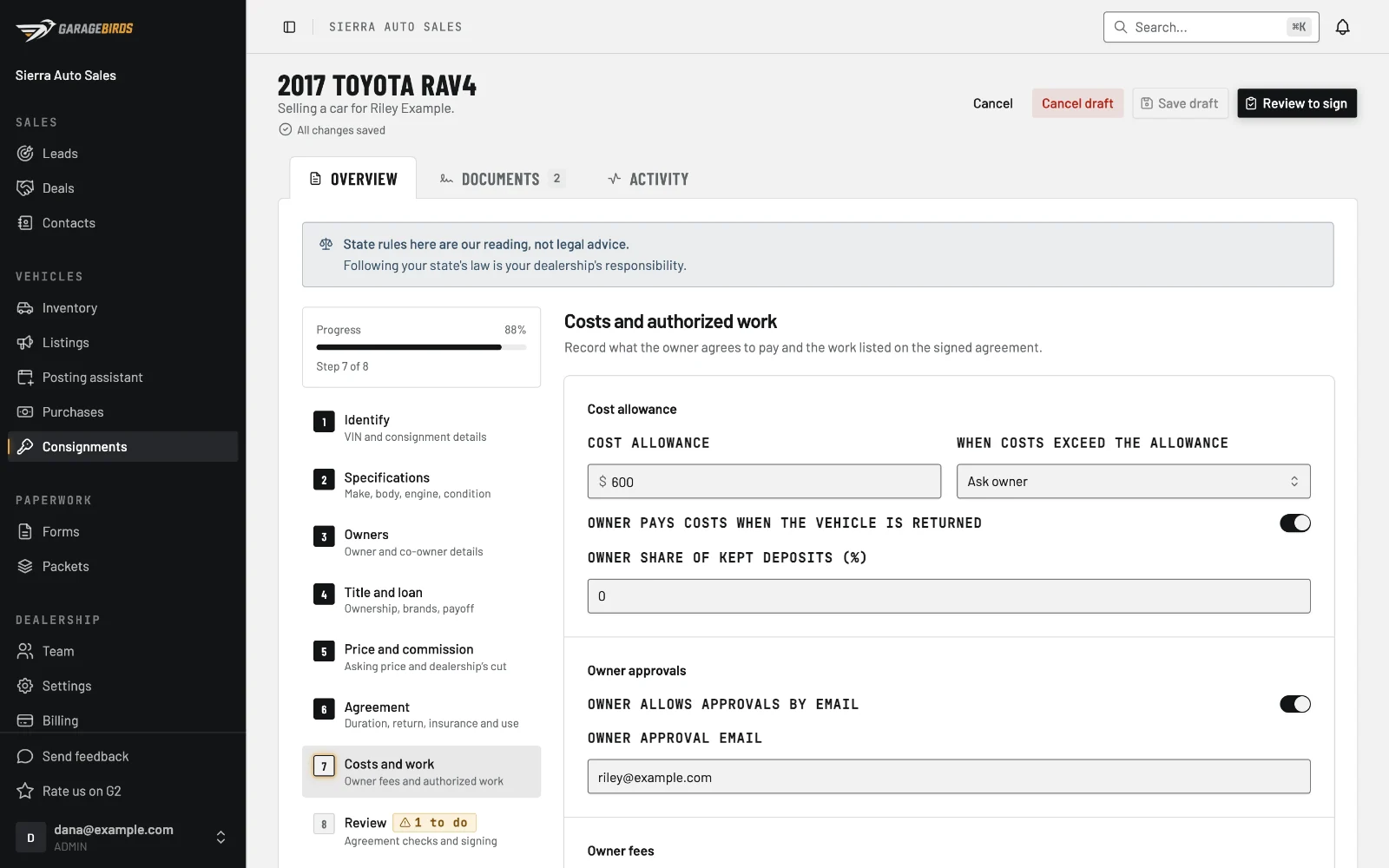
Costs the owner agreed to
Most consigned cars need something before they sell. Agree one total the owner will pay for, the cost allowance, and list the work it covers if you like: detailing, an inspection, oil and fluids, tires, paint and dents, transport, or anything you write in.
- Each cost is charged to the owner or yours. Every cost on the car says which, and who did the work: your shop, or an outside one by name.
- Estimates before the work. You always see the allowance, the expected total, the actual total and what’s left.
- Going over takes the owner’s OK first — on paper, by email from the address they named, or by phone, noted at the time and initialled later. Or set the agreement to cap costs at the allowance, so anything above it is yours.
- A lower price, a longer term or a bigger cut needs the owner’s signed OK, and an extension keeps the original on record. An admin can lower your cut at any time before the payout to keep the owner’s money where it was.
The payout, line by line
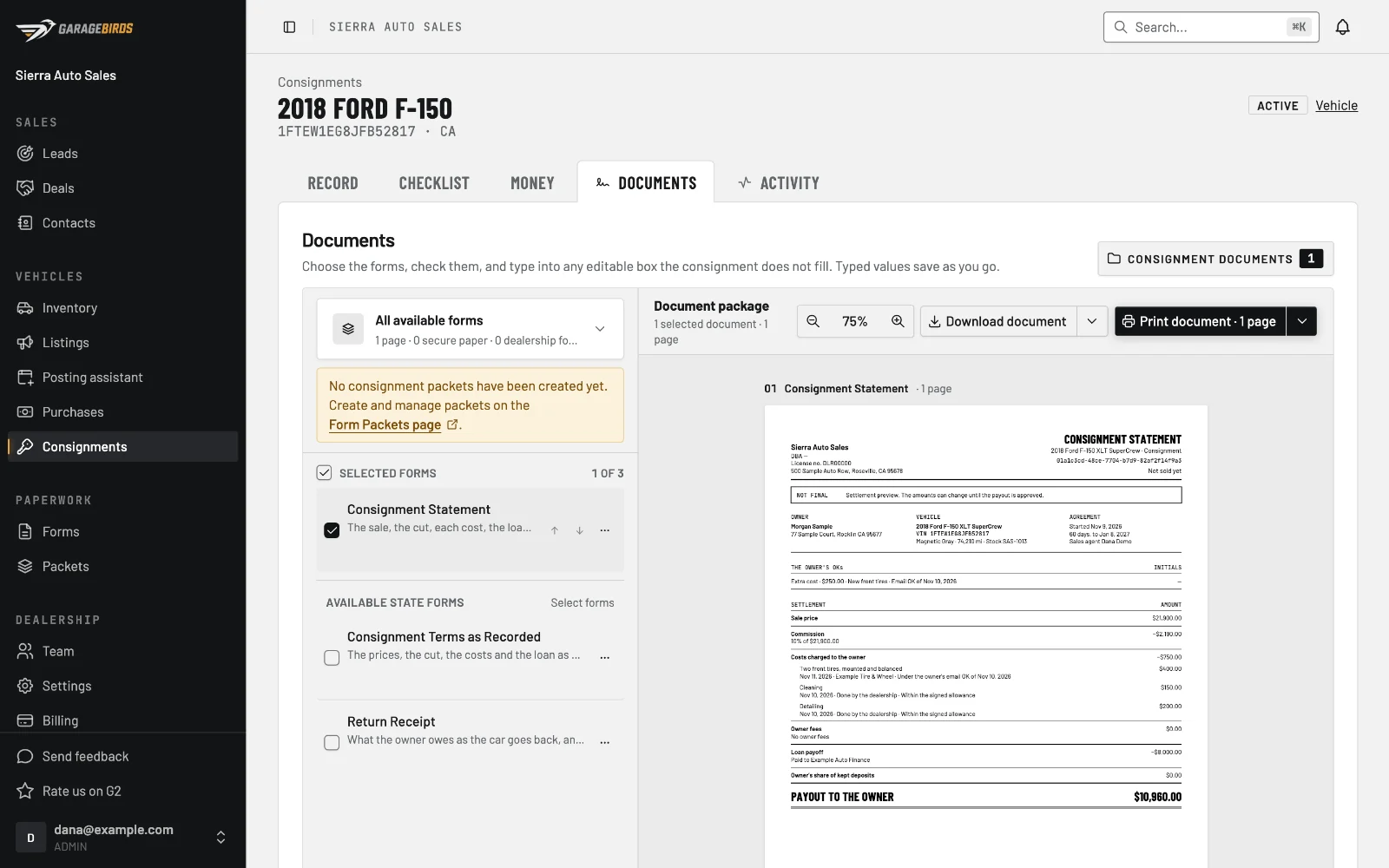
The sale price is the car’s price after any discount. A trade-in on the deal changes nothing for the owner, and tax and government fees pass through. Here’s the 2018 F-150 from our consignment guide, sold for $20,000:
| A worked example | Amount (USD) |
|---|---|
| Sale price | 20,000 |
| Your cut 10% of the sale price | −2,000 |
| Detailing and cleaning within the $500 allowance | −350 |
| New tires took costs over the allowance, so the owner OK’d the extra $250 by email first | −400 |
| Loan payoff paid to the owner’s lender | −8,000 |
| Payout to the owner | 9,250 |
The owner gets an itemized statement with the payout last: the sale price, your cut and how it was worked out, each cost with its date, who did it and the OK it falls under, the loan, any fees, and their share of a kept deposit if the agreement splits one. Before the payout is approved it prints marked not final.
More cars on the lot. None of them bought.
A consigned car has no purchase cost, so your inventory value and expected profit never treat it as bought. Your profit is your cut, after any lowering, plus agreed fees and your share of a kept deposit, minus the costs you paid yourself. In the example, a $120 inspection you paid for makes it $2,000 − $120 = $1,880. The owner’s costs pass through you: never your cost, never your profit.
Due dates, with reminders
Once the car sells, the consignment shows every due date the state sets — the owner told of the sale, the loan paid, the owner paid, the statement given — or the agreement’s own date where the state sets none. Your admins and the car’s agent get a reminder in the app and by email before a date passes, and the consignment shows as overdue after. One list shows every consignment by stage: active, ending soon, sold and waiting for payout with the soonest due date first, overdue, and closed. Admins also get a consignment register.
When it doesn’t sell
When the agreement ends, the car goes back or the owner signs an extension. On a return, GARAGEBIRDS works out what the owner owes under the agreement — the costs charged to them, any return fee, any loan you paid for them — and prints a return receipt for them to sign. It never holds the car; that’s your call. If you’d rather keep it, buy it: the buy-out continues as a private-party purchase, and the costs you’d charged the owner become yours. Damage or theft while you have the car is recorded too.
State rules, with their sources
Consignment is where state law gets specific, and GARAGEBIRDS applies what we’ve read for your state: the agreement form where the state sets one, intake and title steps on the checklist, the payout due dates, a consignment notice for the buyer in the states that require one, and in Arizona, California, North Carolina and Wisconsin the owner as the seller on the title forms. Each rule is labelled as our reading of that state’s law, with the date it was checked and a link to the statute, rule or agency page it comes from. You can add your own checklist items and dates; the state’s stay. Following your state’s law stays your dealership’s responsibility.
Where a state doesn’t allow dealer consignment — Kentucky, Rhode Island, and cars in Iowa — GARAGEBIRDS doesn’t offer it, and points you to buying the car instead.
Free and Pro
Starting a consignment is on Pro: $49 a month billed yearly ($588 a year), or $59 billed monthly, with a 14-day Pro trial with no card, started by an admin from Billing. If you drop to Free, you can still sell, pay out, return and close every consignment you already have open, and read every record; you just can’t start a new one.
Questions
Can GARAGEBIRDS track cars I sell on consignment?
Yes, on Pro. It keeps the owner’s agreement, the costs they agreed to, the sale through an ordinary deal and the payout on one record, with the state’s due dates and an itemized statement for the owner.
How is my cut worked out?
Three ways: a percentage of the sale price, a flat fee, or a fixed amount to the owner with the rest yours. An admin can lower your cut before the payout, for example to cover a discount.
How does the owner OK extra costs?
The agreement sets a cost allowance. Going over it takes the owner’s OK first, recorded on paper, by email from the address they named, or by phone with initials later. Without an OK, the extra work is your cost.
Does GARAGEBIRDS pay the owner or contact them?
No. It records the payoff and the payout you make, and prints what the owner signs. You talk to the owner yourself.
What if the loan is bigger than the sale price?
The car can come in, but the sale can’t be finalized while the owner’s payout would be negative. The owner pays the gap, the lender takes less, or the price goes up.
Is consignment available in every state?
In every state whose law allows dealer consignment. Kentucky and Rhode Island don’t, and Iowa allows it only for heavy trucks, so GARAGEBIRDS doesn’t offer it there. Each rule it applies elsewhere is our reading of that state’s law, linked to its source, and not legal advice.
Take in your first consignment
Start on the Free plan; an admin can turn on Pro’s 14-day trial from Billing whenever you’re ready, with no card.